
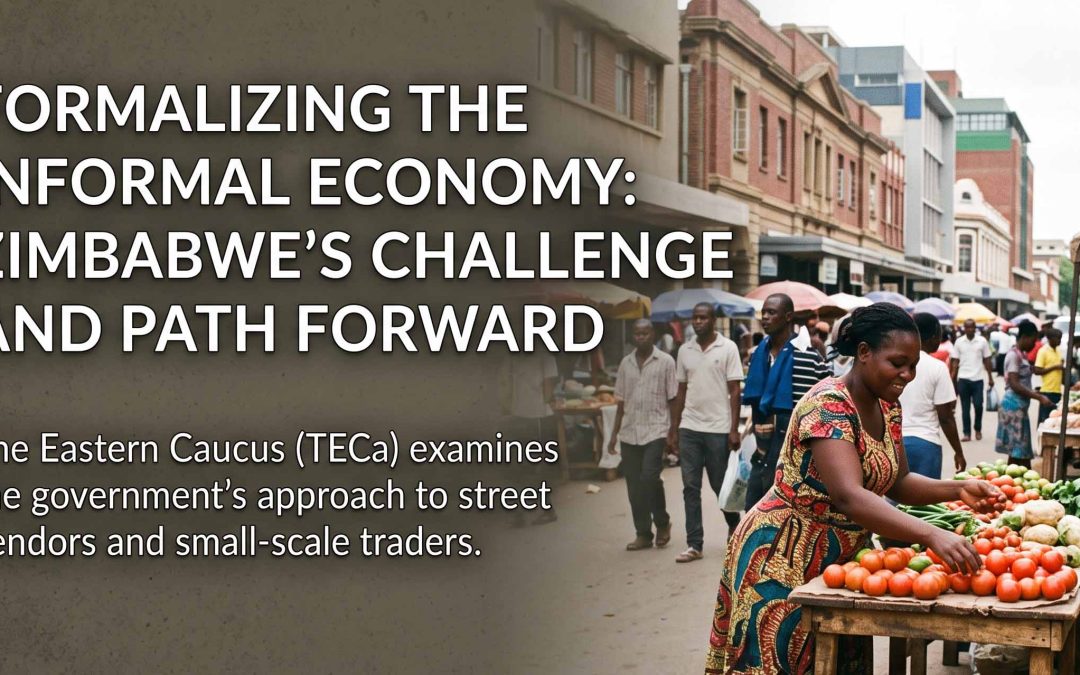
On September 3, Zimbabweans awoke to news of a looming national operation to clear vendors and small-scale traders from the streets. The issue is not whether these businesses are technically legal, but how government policy can best guide them from informality into the formal economy — without destroying livelihoods in the process.
Just four months ago, Vice President Kembo Mohadi launched a national formalisation policy designed to do exactly that. It promised to:
- Register traders and bring them into the tax net.
- Enable relocation through structured planning.
- Provide access to finance by using registration certificates as proof for bank loans.
- Boost investor confidence by showing order and predictability.
Minister Garwe’s sudden declaration — “leave the streets or face confiscation and arrest” — undermines this orderly approach. Instead of building trust, it risks chaos, wasted resources, and shattered confidence.
Why This Policy Hurts
- Opportunity cost: Deploying fuel, manpower, and money for raids is wasteful compared to supporting ZIMRA and councils to register traders.
- Economic impact: Micro and small traders drive 74% of national demand. They feed, clothe, and educate millions.
- Trust deficit: Policy reversals erode confidence in government pronouncements, threatening both the ZiG currency and the 2030 upper-middle-income vision.
- Contradiction of NDS II: The “whole of government approach” is compromised when livelihoods are sacrificed for cosmetic urban order.
Global Lessons
Zimbabwe has just begun to climb out of the “repressed” category on the Economic Freedom Index. Heavy-handed interventions risk reversing these gains. Countries like Norway and Botswana show that prosperity rests on policy certainty, strong institutions, sound money, and respect for property rights. Zimbabwe has comparable resources but remains far behind due to policy volatility.
The Way Forward
The government must return to the formalisation policy. Resources should strengthen the Ministry of SMEs, ZIMRA, ZIDA, and local authorities to register traders, integrate them into the tax system, and open financial doors. This includes supporting graduates under the 5.0 education policy with dedicated portals for new ventures.
Populist clean-up campaigns may create the illusion of order, but they destroy trust, livelihoods, and economic freedom. Zimbabwe’s path to prosperity lies not in coercion, but in predictability, inclusivity, and reform.
Issued by The Eastern Caucus (TECa)- a classical liberal economic think-tank in Zimbabwe
Mutare, September 3, 2026.