
By staff writer
There is a flurry of policy issues dominating the Zimbabwean media, from global to local. The impact of the war in the Middle East on Zimbabwe’s productive sector costs of commodities like fuel and energy is topical. Lately, fuel prices have risen by 20 US cents to an average $1.71/litre. On the domestic front, the government has issued a policy statement that they will honour local contracts on the local currency, the Zimbabwe Gold (ZIG). The government, sitting as Cabinet on March 17, 2026 also approved a raft of levies and fee reductions to ease the cost of doing business.
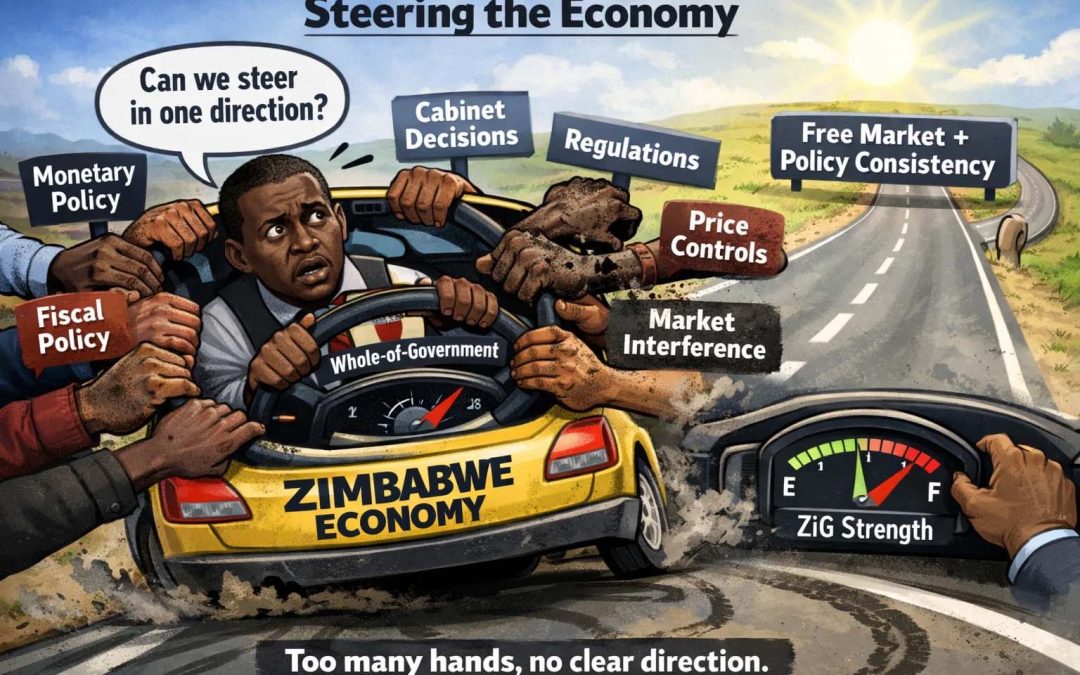
In this policy discussion, we wish to raise three issues. These include: a) encourage the government to be active with its whole-of-government policy approach, b) focus on making conditions for sound money to exist and thrive, and c) reduce government expenditure to shore up savings.
Why not go back to whole of government approach?
A whole-of-government approach is a policy process that eliminates ministerial silos and looks at proposed policy from multiple lenses. The ongoing ease of doing business reforms concerns many ministries and departments. Under Zimbabwe’s National Development Strategy (NDS) 1, it was announced that the Office of the President and Cabinet (OPC) chair these cross-ministry policy meetings to ensure policy consistency, policy congruence, policy clarity and policy certainty. These four are foundational pillars for building trust and enhancing the legitimacy of government policy. Policy pronouncements that seem abrupt, detached and fragmented often fail the public confidence test.
We emphasise this point as the government has, over the past sixty days, been announcing serious policy issues discretely. The 2026 Monetary Policy Statement was presented on February 27, 2026. And yet, barely four weeks later, the Minister of Finance and the Central Bank co-announce the payments of local contracts in the Zimbabwe Gold (ZiG). The cabinet meeting of March 17 also announced a series of tax, fee and levy reductions across the agricultural sector. Whilst this is all progressive, we call for scheduled and predictable policy announcements. This increases policy predictability, and reduces shocks and uncertainty in the market.
Payment of contracts in Zimbabwe Gold (ZiG) and emerging “dirty hands”
The announcement that the government will settle all local contracts in ZiG has ignited mixed reactions. The most significant one being the fear of repetition of history where the Government introduced the Bond Note on November 28, 2016. They celebrated the fete with the declaration that its value equal to the United States Dollar. They argued that it’s stability was backed by gold reserves.
We encourage the Reserve Bank of Zimbabwe to pursue a tight monetary policy position that is anchored by open market conditions.
Secondly, the proverbial hands of the state in the market, which have been called “price-discovery mechanism” in the foreign currency market, and the “national standard price list” for settlement of government contracts are worrying. The local currency cannot be strong because of these “dirty hands”, but sound and complementary fiscal and monetary policies. We encourage the government to receive its payments of taxes, fees and levies in the local ZiG currency, whilst also tightening its expenditure to lessen the demand for foreign currency. When maintained well, the ZiG can gain its own weight. It makes it tradable even across the southern African region.
The government must be bold, and even allocate travel allowances in the local ZiG and allow travellers the opportunity to get their foreign currency at Bureau de Change. This is the open market state that will display a strong ZiG.
In conclusion, we express our appreciation for the ongoing ease of doing business reforms, largely represented by tax, fee and levy reductions across the economy. The government must be bold enough to maintain its whole-of-government approach to policy making under National Development Strategy (NDS) 2 and ensure it maintains a restrictive fiscal policy, as well as adhering to the strict code of public administration to eliminate waste.
As has been argued by other economic scholars, Zimbabwe has almost everything it needs to prosper. The main factors being freeing the economy from “visible dirty hands/controls” and allowing the market to determine prices, as well as a limited but efficient government.
Next week, we start new lines of discussion in our pursuit of liberty and prosperity in Zimbabwe!