
By Tanyaradzwa Janhi
This article discusses the emerging economic challenges emerging out of unfair productive economic costs of industries relying on the so-cold “clean” and often more expensive energy versus those using the traditional coal and carbon based, the so called “dirtier energy”. Whilst this discussion seems remote to a polity like Zimbabwe, which still struggles to fully satisfy her net energy requirements even using fossil fuel energy, the case has to be discussed, on how will she, assuming she were to shift towards energy transition, manage the impending imbalance.
As nations accelerate their transition toward a net-zero future, a fundamental economic paradox has emerged: How can a country impose strict environmental costs on its own industries without inadvertently giving a competitive advantage to “dirtier” foreign rivals?
The answer increasingly lies in the Carbon Border Adjustment Mechanism (CBAM) a sophisticated form of “climate tariff” designed to align global trade with environmental responsibility.
While its logic is compelling, the rollout of CBAMs in 2026 has ignited a complex debate around trade equity, industrial survival and the real cost of going green particularly for developing economies like Zimbabwe.
The Dilemma of Carbon Leakage
At the heart of the CBAM is the challenge of carbon leakage. When jurisdictions impose high carbon prices domestically, they risk distorting competition. Local manufacturers face higher production costs, which can lead to:
- Industrial flight: Companies relocate to countries with weaker environmental regulations
- Import substitution: Consumers shift toward cheaper, high-carbon imports
Without intervention, strict climate policies may fail to reduce global emissions they simply relocate them.
The CBAM acts as a corrective mechanism, ensuring that the carbon cost of a product is accounted for regardless of where it is produced. In essence, it levels the playing field between domestic and foreign producers.
Mechanics of a Climate Tariff: From Europe to the UK
CBAMs apply fees to carbon-intensive imports such as steel, aluminum, cement, fertilizers, and electricity.
- European Union: As of January 1, 2026, the EU’s CBAM entered its definitive phase. Importers must now purchase certificates reflecting the embedded emissions of their goods, with prices linked to the EU Emissions Trading System.
- United Kingdom: The UK will introduce its own CBAM in January 2027, expanding coverage to sectors like glass and ceramics—demonstrating how countries are tailoring policies to protect vulnerable industries.
These mechanisms create a powerful global incentive: countries that implement their own carbon pricing systems allow their exporters to avoid paying border tariffs abroad. In this way, CBAMs function as both a penalty and a diplomatic nudge toward global carbon pricing convergence.
Zimbabwe in the Crosshairs: Risk and Opportunity
For Zimbabwe, the rise of CBAMs presents both a threat and an opportunity.
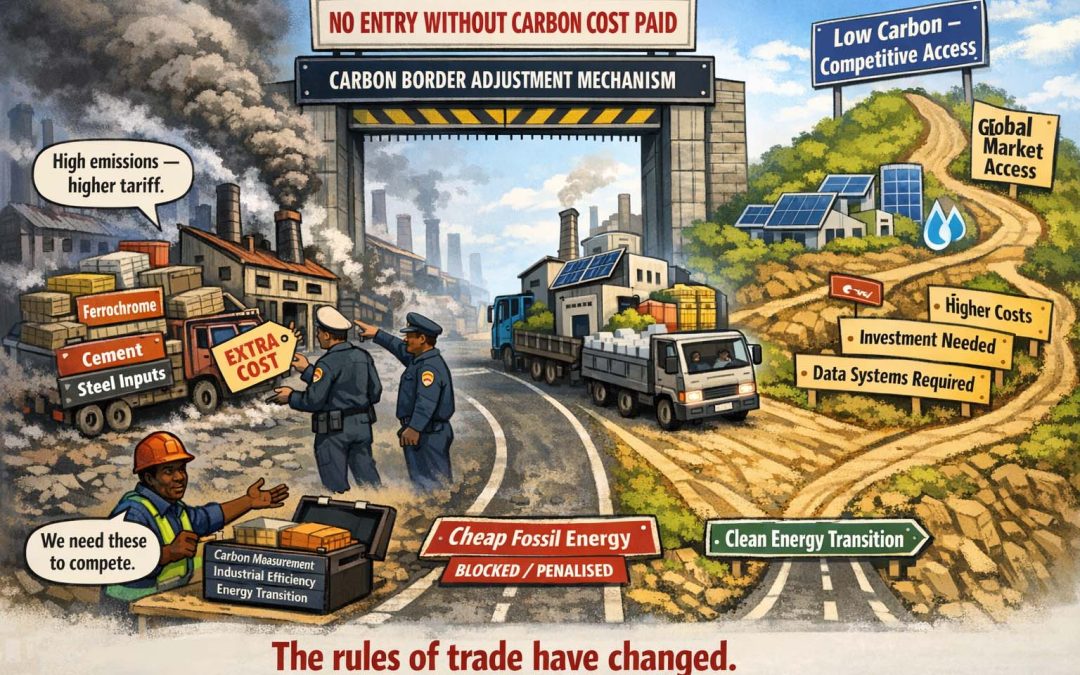
Zimbabwe exports key raw materials such as steel inputs, ferrochrome, and cement-related products to international markets, including regions that are adopting CBAMs. Without a domestic carbon pricing framework or transparent emissions data, Zimbabwean exports risk being taxed based on “default” high-emission assumptions, making them less competitive.
For example:
- Ferrochrome exports, a major foreign currency earner, are energy-intensive due to reliance on coal-powered electricity. Under CBAM rules, these exports could face significant tariffs unless emissions are reduced or properly measured.
- Cement production, driven by companies like PPC Zimbabwe, may also face indirect pressure as construction materials fall under scrutiny in global supply chains.
However, there is also a strategic opportunity. Zimbabwe’s growing investments in hydropower (Kariba) and solar energy projects could position the country as a producer of relatively lower carbon goods if properly measured and certified.
Developing a national carbon accounting system could allow Zimbabwe to retain tax revenue domestically rather than effectively “exporting” it to foreign customs authorities.
The Economic Tug-of-War: Responding to the “Green Barrier”
Globally, reactions to CBAMs vary sharply.
- China has expanded its emissions trading system to include heavy industries like steel and cement, ensuring that carbon revenues stay within its borders.
- India has criticized CBAMs as protectionist, though it has entered technical discussions to help its industries adapt.
For Zimbabwe and other African economies, the concern is similar: CBAMs risk becoming de facto trade barriers that penalize countries with limited technological and financial capacity to decarbonize quickly.
At the same time, the phenomenon of “greenflation” is becoming more visible. As carbon pricing raises production costs globally, the price of essential materials increases. For Zimbabwe, which already faces high construction and import costs, this could translate into:
- More expensive infrastructure projects
- Higher housing costs
- Increased prices for imported machinery and manufactured goods
Hurdles in 2026: Data, Capacity, and Diplomacy
A major challenge facing CBAM implementation is data transparency. Accurately measuring the carbon content of products requires robust monitoring systems—something many developing countries, including Zimbabwe, currently lack.
Without credible data:
- Exporters risk being assigned inflated emissions values
- Countries lose the ability to defend their competitiveness
This highlights an urgent policy gap. Zimbabwe will need to invest in:
- Emissions measurement and verification systems
- Industrial efficiency upgrades
- Engagement in international climate and trade negotiations
There is also a diplomatic dimension. African nations may need to collectively advocate for transitional support, including climate finance and technology transfer, to avoid being unfairly disadvantaged in the emerging green trade regime.
Conclusion
Whilst there is global pressure, and a seeming norm to drift towards clean energy sources, Zimbabwe has to fully appreciate the costs. The unfair market conditions are real, that goods produced by fossil fuels would land on the market cheaper. The question becomes, how would this make trade fairer, especially in the context of more trade liberalization at the global level. The Carbon Border Adjustment Mechanism represents a profound shift in how environmental costs are integrated into global trade. It acknowledges a simple truth: free trade cannot be truly fair if environmental costs are unevenly distributed.
For Zimbabwe, the CBAM is not just an external policy it is a signal. A signal that the future of trade will be shaped as much by carbon efficiency as by price competitiveness.
While the transition carries risks higher costs, trade friction, and capacity challenges it also offers a pathway. With the right investments in clean energy, data systems, and industrial policy, Zimbabwe can reposition itself not as a victim of green trade rules, but as a competitive player in a low-carbon global economy.
The green guardrail is rising. The question is no longer whether to adapt but how quickly and strategically it can be done.
Tanyaradzwa Janhi is a development studies scholar. She is currently researching with The Eastern Caucus (TECa) economic think-tank.