
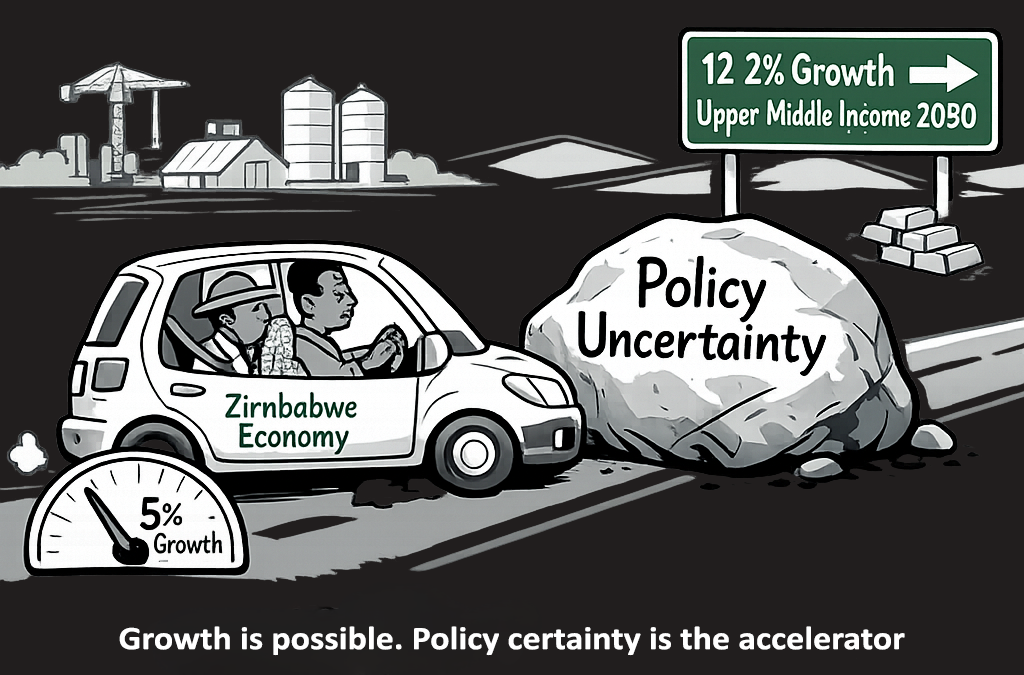
Zimbabwe is experiencing an economic bubble. The national
savings are rising as indicated by a one-and-half import cover. The local
currency inflation rate has fallen to 4,1%. The consumption of diesel has
increased to 1.2 billion litres per year from 700 million in 2024. Gold, tobacco,
maize, and other produce have risen sharply. New buildings are emerging, and
cranes are becoming a common sight in the capital city’s skyline. Growth
points and new agricultural lands are being expanded. Yes, there is a widening
income gap in society, but, evidently, Zimbabwe is experiencing an economic
bubble. The question is: what then is needed to accelerate this bubble to drive
more prosperity? The current 5% growth rate is not sufficient to take
Zimbabwe into an upper middle-income society by 2030. Zimbabwe needs a
growth rate of 12.2% per year. We argue that Zimbabwe needs policy certainty
now, more than ever.
The debate on what is needed for less prosperous nations to unlock their
economies has been long-drawn. Often at the core, are the paradox of plenty
where nations are often resource rich but poor. That is Zimbabwe’s case and
curse. The country is well endowed with resources like minerals, great
weather, fertile soils, an agile human resource base and general peace in the
region. But, by all indicators, the country sits in the class of less prosperous
nations. It’s local currency, the Zimbabwe Gold (ZiG) still plays less than 17%
role in the economy with the US dollar playing the major role, 83% plus.
Societal prosperity as measured by people’s savings, the welfare of children
and the elderly, education and health opportunities or transport options all
indicate a struggle.
However, as published variously by other think-tanks. Zimbabwe needs policy
certainty to accelerate its growth into an upper-middle-income society. The role
of the state must be focused on facilitating development whilst the private
sector leads in development. It is our view that the invisible hand is big and
very active in Zimbabwe, thereby raising the cost both in monetary terms and
risk of doing business in Zimbabwe.
Policy certainty refers to a rules-based-polity where actors are confident of the
security of their investments, as well as confidence in the purity of institutions
to protect their freedoms and rights. Chapter 9 of the Constitution is clear on
the need for proper public administration. Institutions of the state must be
independent and efficient. The judiciary, parliament and other institutions like
the Auditor General, the anti-corruption commission, the procurement and
regulatory authority of Zimbabwe (PRAZ) as well as the media ought to be
independent.
The government has to be deliberate and bold in this move and free these
institutions and spaces for the economy to flourish. Capital is fungible (highly
mobile) across nation-states. Whilst Zimbabwe has competitive margins of
returns for capital, uncertainty is a big deterrent to long-term capital.
The political leadership will also benefit from these rule-based-systems as they
also protect them when their political tides are low. Market forces and rule of
law must drive growth, and not proximity to power or extra-ordinary rentals to
gate-keepers at mines or markets. Policy certainty and free institutions are the
game changers!