
Staff Writer – Zimbabwe’s Finance Minister, Prof. Mthuli Ncube, presented the Mid-Term Fiscal Review in Parliament on Thursday, July 31, 2025, leaving tax reform calls unresolved.
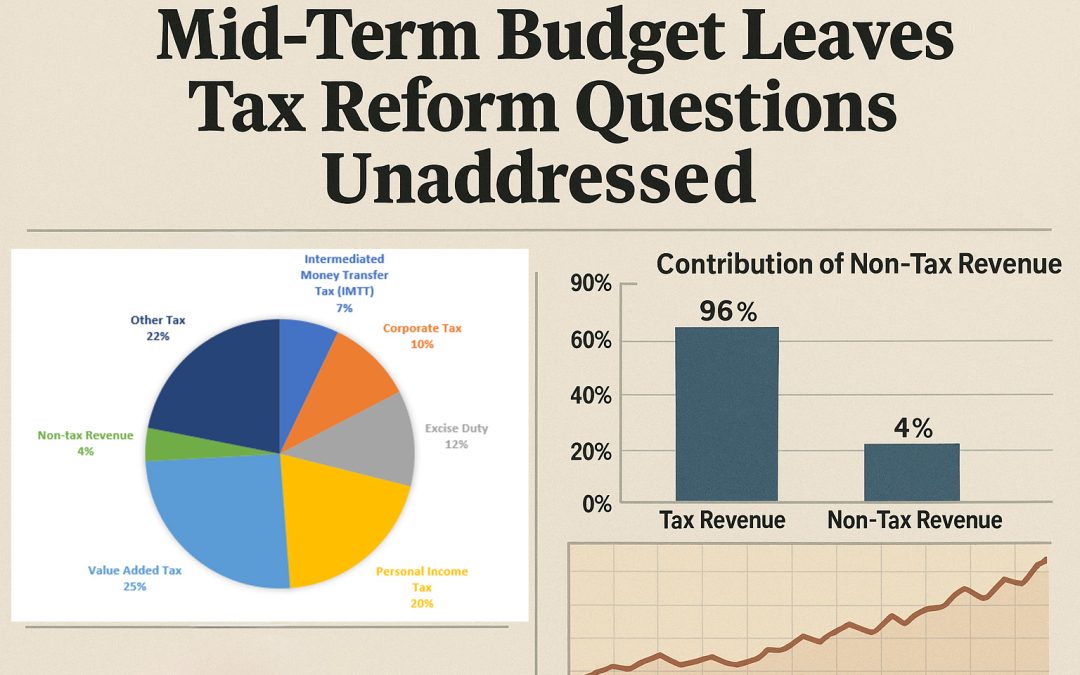
The contribution of non-tax revenue to Zimbabwe’s domestic resource mobilisation also remains low at 4%.
During the first half of the year, taxes contributed to 96% of revenue, with the controversial Intermediated Money Transfer Tax (IMTT), one of the major contributors, turning in 7.1%, corporate tax 10.3%, excise duty 11.5%, personal income tax 19.9%, and Value Added Tax 25.3%.
Exceeding revenue targets, the Minister attributed the revenue collection performance to increased compliance on streams such as the Beverages Sugar Content Tax, enhanced tax administration, including audits on smuggled goods, and rolling back VAT exemptions.
Ahead of the Mid-Term Budget presentation, key sectors of society, including business and ordinary people, had been calling for the government to reform the country’s burdensome tax regime, a plea that the Minister left unresolved in the Mid-Term Review.
The National Competitiveness Commission (NCC), in July 2025, released its 2024 report, highlighting that the country’s economic development was being hampered by a tax regime that is making it hard for companies to thrive.
Similar evidence of the need to reform the country’s tax regime was presented by the Zimbabwe National Chamber of Commerce (ZNCC), Chamber of Mines, and Confederation of Zimbabwe Industries (CZI).
Speaking to journalists at Parliament, after his presentation, giving the example of the diary industry, the Minister admitted that the country’s regulatory environment and requirements would make any entity that complied go out of business.
“The cost of doing business is a big issue for our private sector,” he said.
“In some businesses, you can only be profitable if you don’t comply. So you have to cheat the government to remain in business. And the dairy sector is one such sector where we have found out that, if dairy farmers complied with all our regulatory requirements as the government, they would not make money.”
Despite these admissions, the budget process left the tax reform questions unaddressed, with the Minister repeating prior commitments made from as early as mid-2024 to engage stakeholders and find solutions.
The presentation left no doubt, however, that tax interventions remain part of the Minister’s domestic resource mobilisation (DRM) agenda.
The Treasury boss promised to expand “the tax base to fully incorporate emerging sectors” and “support formalisation of economic activities through digital and financial inclusion of SMEs.”
Acknowledging concerns raised by taxpayers and business organisations, the Minister said, “Government will continue to review the existing tax system with a view to reducing observed and reported distortions…”
He set his targets on “business growth and competitiveness within and on the regional and international market, investment and compliance to (sic) tax legislation…”
Ordinary people and businesses have complained about the Intermediated Monetary Transfer tax (IMTT).
Though the Minister confirmed that tax regime reform consultations were underway, ZITAP believes this is an urgent issue.