
By Hillary Munedzi
The EU-Zimbabwe trade has indeed seen significant growth, with a 30% increase reaching $880 million. This growth is attributed to the Economic Partnership Agreement (EPA) between the EU and Zimbabwe. The EPA allows Zimbabwean companies to export duty-free and tariff-free to the EU, promoting trade and investment between the two regions.
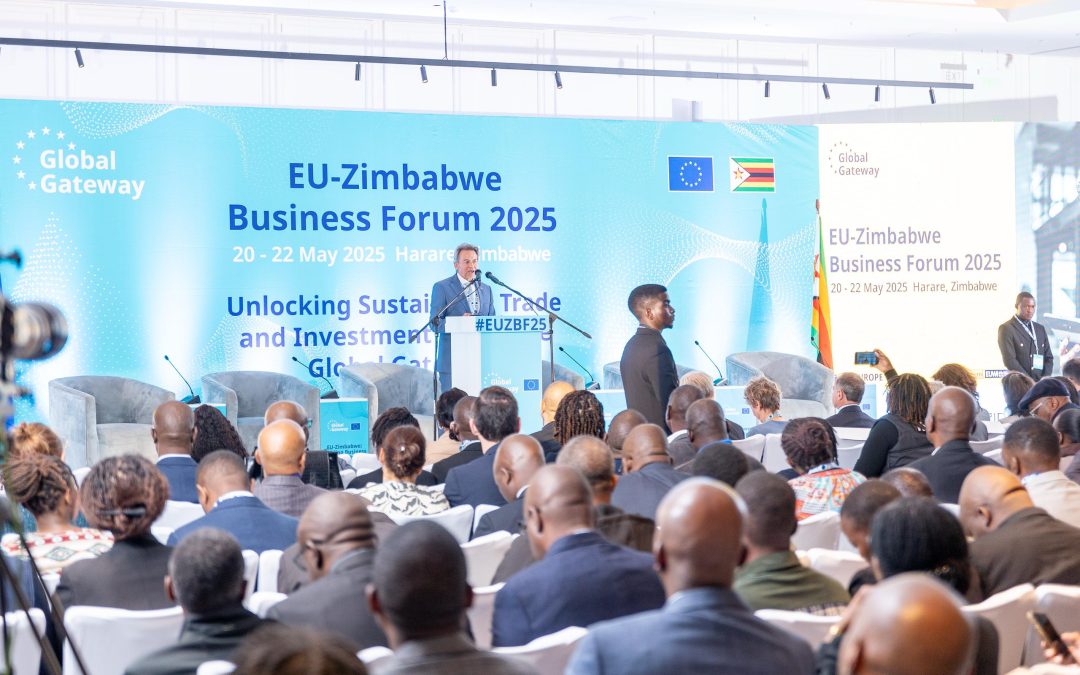
The first-ever EU–Zimbabwe Business Forum was officially opened in Harare recently, marking a milestone in efforts to strengthen trade and investment ties between the European Union and Zimbabwe.
Speaking during the event,EU Ambassador Jobst von Kirchmann highlighted that the idea for the Forum was born just a year ago—an ambitious vision that has materialised faster than many expected.
“When we looked at the positive development of trade and investment with the EU over the last years, we felt that the time was ripe to bring EU companies to Zimbabwe,”said Ambassador Jobst von Kirchmann.
Concerns around currency volatility, regulatory unpredictability, and access to finance are frequently raised by prospective investors. In this context, the Forum is designed not to overlook these realities, but to provide a frank and constructive space for dialogue and connection.
The Forum also coincides with broader developments in EU–Africa trade relations. Negotiations to deepen the Economic Partnership Agreement (EPA) between the EU and the Eastern and Southern Africa region—including Zimbabwe—are progressing. If finalised, this would be the first such agreement between the EU and an African region, potentially enhancing trade and investment.
Global attention lately has fixated on the challenges and tensions fracturing the Western-led world order, such as “America First” policies, the fraying of decades-old alliances, dramatic US tariff increases on all its global trade partners, and Europe’s struggle to remain competitive.
Several key characteristics illustrate the growing agency of African nations. While highly diverse, they share a focus on economic growth and on deepening trade and investment links with the rest of the world. Africa multi-aligned and unencumbered by the geopolitical agendas of the legacy major powers. African countries are increasingly forming new trade, technology, and economic development partnerships that align with their own strategic priorities, rather than simply responding to external pressures. And they’re taking a pragmatic approach to climate action, balancing growth with sustainability.
Perhaps more crucially, Africa is where the future is being built. African economies will account for the lion’s share of global growth well into the future, defining the next wave of economic opportunity. They also hold what the world needs: critical resources to secure global supply chains, young and expanding workforces, and growing consumer markets.