

How Currency Instability Has Crushed Innovation and the way forward for Zimbabwe!
By Blanche Wadzanai Mhonda
Introduction
Zimbabwe’s post-independence economic journey is a cautionary tale of what happens when sound monetary principles are abandoned. From 1980 to 2024, the country’s currency has gone through multiple iterations, each plagued by inflation, devaluation, and collapse. The graph tracing the Zimbabwean dollar’s exchange rate against the U.S. dollar tells a story of extreme volatility. But beyond the numbers lies a deeper impact: how poor monetary policies have systematically undermined entrepreneurship in the country.
Currency Volatility and Entrepreneurial Impact
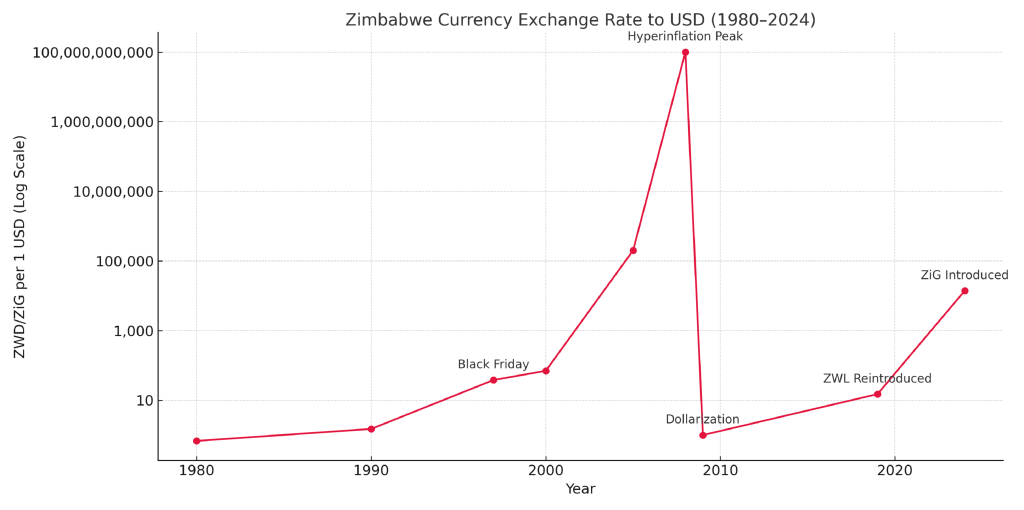
Figure: Historical Exchange Rate of Zimbabwe’s Currency Against the U.S. Dollar (1980–2024). This graph illustrates major periods of volatility including Black Friday (1997), hyperinflation (2008), dollarization (2009), and the introduction of the gold-backed ZIG in 2024. (Source: Wikimedia Commons, 2024)
Sound money by definition, retains its value over time and serves as a reliable medium of exchange. Mbambi, T (2024), noted that, in Zimbabwe, inconsistent monetary policies from reckless printing of money to abrupt currency changes have made it impossible for entrepreneurs to plan, invest, or grow. During the hyperinflation crisis of 2008, for example, the government printed excessive amounts of currency to cover fiscal deficits. At the height of the crisis, inflation reached an astronomical 79.6 billion percent. Prices doubled every few hours. Entrepreneurs, who rely on price stability for inventory management, payroll, and service delivery, were left helpless.
While the 2009 adoption of a multi-currency regime, led by the U.S. dollar, restored temporary stability, policy inconsistency soon returned. By 2019, authorities reintroduced the Zimbabwean dollar without sufficient reserves or institutional trust, sparking renewed inflation. Entrepreneurs again faced a familiar scenario of uncertainty, loss of value, and flight of capital.
Policy Failures and Missed Opportunities
These monetary missteps are deeply tied to broader policy failures. Lack of central bank independence, fiscal indiscipline, opaque decision-making, and reactive rather than proactive economic planning has fueled Zimbabwe’s economic crises. Entrepreneurs, especially small and medium-sized enterprises need policies that ensure macroeconomic stability, reliable access to capital, and clear regulatory frameworks. Without these, innovation is stifled and informal survivalist business models become the norm.
The ZiG and the Way Forward
The introduction of the gold-backed Zimbabwe Gold (ZiG) currency in 2024 reflects an attempt to reset the economy and restore confidence. While pegging to gold may limit arbitrary currency manipulation, its success depends on whether supporting policies are credible and transparent. For ZiG to offer real support to entrepreneurs, several key reforms are essential.
The Way Forward
First, the government must guarantee central bank independence and end political interference in monetary policy. Second, fiscal responsibility laws should be enacted to cap deficit spending and limit reliance on monetary financing. Third, policymakers must strengthen property rights and contract enforcement fundamentals that reduce risk and encourage investment. Fourth, a stable exchange rate regime and a credible framework for inflation targeting would help anchor expectations.
Additionally, policies should foster financial inclusion, especially for informal entrepreneurs who have been historically locked out of formal credit systems. A digital payment infrastructure backed by a stable currency could open new markets and reduce transaction risks.
In essence, Zimbabwe’s entrepreneurial revival is not just about fixing the currency. It’s about committing to sound economic governance. When policy supports stable money, rule of law, and predictable institutions, entrepreneurs can innovate, create jobs, and drive sustainable growth. Only then can Zimbabwe transition from crisis-prone to opportunity-driven.